
What Is Social Communication? Signs Your Child May Need Support + How Speech Therapy Can Help
So your child has a great vocabulary, tells you all about the things they love, and has no trouble communicating their wants and needs.
But conversations with other kids? Making and keeping friends? Knowing what to say or how to join in? Those things may not come quite as easily.
This is where social communication comes in.
I recently sat down with the Arizona Pediatric Assessment Center for an episode of Beyond the Assessment to talk about social communication, speech therapy, and some of the questions I hear regularly from parents.
We talked about what social communication or pragmatic language actually is, signs that a child may benefit from additional support, what to look for when considering a social skills group, and more.
If you've ever wondered about your child's social struggles or whether there may be specific skills they need help learning, this conversation is a great place to start.
Watch: The Skill Most Parents Miss — Social Communication with Kids
In this interview, we discuss:
What social communication and pragmatic language actually mean
Signs of social communication difficulties parents may notice
Social skills groups and speech therapy
What to look for when choosing a social skills group for your child or teen
R sounds, lisps, and when to consider a speech evaluation
Using Arizona ESA funds for speech therapy services
What Is Social Communication?
Social communication is how we use language to connect and communicate with other people.
There are many different skills involved in having a conversation or interacting successfully with someone else. For example, a child may need to figure out how to:
Start a conversation
Ask questions
Share information about themselves
Stay connected to the topic
Notice whether the other person is interested
Understand social cues
Join a conversation that's already happening
Know when and how to end a conversation
Understand humor, sarcasm, and nonliteral language
Navigate disagreements or misunderstandings
Adjust what they say depending on the person or situation
For many kids, especially neurodivergent kids and teens, these skills aren't necessarily something they simply "pick up" by spending more time around other children.
And that's an important distinction.
A child can be bright, funny, kind, and genuinely interested in having friends while still needing more explicit support to understand some of the unwritten rules involved in conversation and friendship.
What Can Social Communication Difficulties Look Like?
Social communication challenges don't look the same for every child.
You might notice that your child:
Talks at length about a favorite topic without realizing the other person has lost interest
Rarely asks the other person questions back during conversations
Gives very short answers and isn't sure how to keep a conversation going
Has difficulty staying on topic
Misses subtle social cues
Has trouble joining conversations or groups of peers
Says things that come across differently than they intended
Struggles to understand sarcasm, humor, or implied meaning
Wants friends but isn't sure how to initiate or maintain those friendships
May be able to initially make friends, but maintaining those friendships longer-term is a challenge
Frequently feels left out or confused about what went wrong in a social interaction
Sometimes these differences are fairly obvious. Other times, parents simply have a sense that something isn't clicking socially, even though they can't quite put their finger on what it is.
That's one reason understanding social communication can be so helpful. Instead of viewing "social skills" as one big ability that a child either has or doesn't have, we can break social communication down into smaller skills and identify where additional support may be helpful.
Can Speech Therapy Help With Social Communication?
Yes! Social communication, also called pragmatic language, is one of the areas speech-language pathologists can assess and support.
Speech therapy isn't only about pronunciation or helping children learn to talk.
Speech-language pathologists work across many areas of communication, including the skills involved in using language effectively in social situations.
For a child who struggles with social communication, that might mean explicitly breaking down a complicated skill like "having a conversation" into smaller, more manageable pieces.
Instead of simply telling a child to "talk to people more," we can help them understand how conversations work, practice specific strategies, and give them opportunities to try those strategies in real-world situations.
The goal isn't to change who a child is or teach them to hide their neurodivergent traits.
It's to give them tools they can choose to use so they feel more confident navigating conversations, friendships, and social situations while still communicating authentically.
What Should I Look for in a Social Skills Group?
It’s important to know that not all social skills groups are the same.
We also talk in the interview about an important question for parents considering group support:
Is the group actually teaching social communication skills, or is it primarily providing an opportunity to socialize?
There's nothing wrong with a fun social group. Having opportunities to spend time around peers with shared interests can be incredibly valuable.
But if your goal is for your child to learn specific social communication skills, it's worth asking what is actually being taught.
A structured social communication program should go beyond simply placing kids together and hoping they'll learn from one another.
Look for opportunities for explicit instruction, modeling, guided practice, feedback, and support carrying those skills into everyday life.
For example, in my CONNECT Program, participants don't just practice "being social." We break skills like starting conversations, maintaining conversations, joining groups, navigating electronic communication, handling disagreements, and building friendships into concrete steps that kids can understand and practice.
For many neurodivergent learners, making those invisible social expectations more visible can make a big difference.
Can Speech Therapy Help With R Sounds and Lisps?
Although much of my work focuses on social communication, speech sound disorders are another specialty area of my practice and one I have extensive experience treating, particularly persistent R sound errors and lisps.
In the interview, we also talk about R sounds and lisps, including when it may be helpful to seek an evaluation rather than continuing to wait for a child to “grow out of it”.
If you’re unsure whether your child’s speech sound errors are still developmentally expected or whether additional support may be appropriate, a speech-language evaluation can help clarify what’s going on. Because speech sound development can vary based on a child’s age and the specific sound or error pattern, an evaluation can help determine whether the errors are typical for their age, how much they may be affecting overall speech clarity, and whether speech therapy is recommended.
How Do I Know if My Child Needs Speech Therapy?
If you have concerns about your child’s communication but aren’t sure whether speech therapy is needed, you don’t have to have all the answers before reaching out. Sometimes the first step is simply learning a little more about what’s typical and where your child may be having difficulty.
If your concerns are related to conversations, friendships, or social communication, you can start with my free Conversation Skills Quiz. It can help you take a closer look at some of the specific conversation skills your child may be struggling with and whether additional support could be helpful.
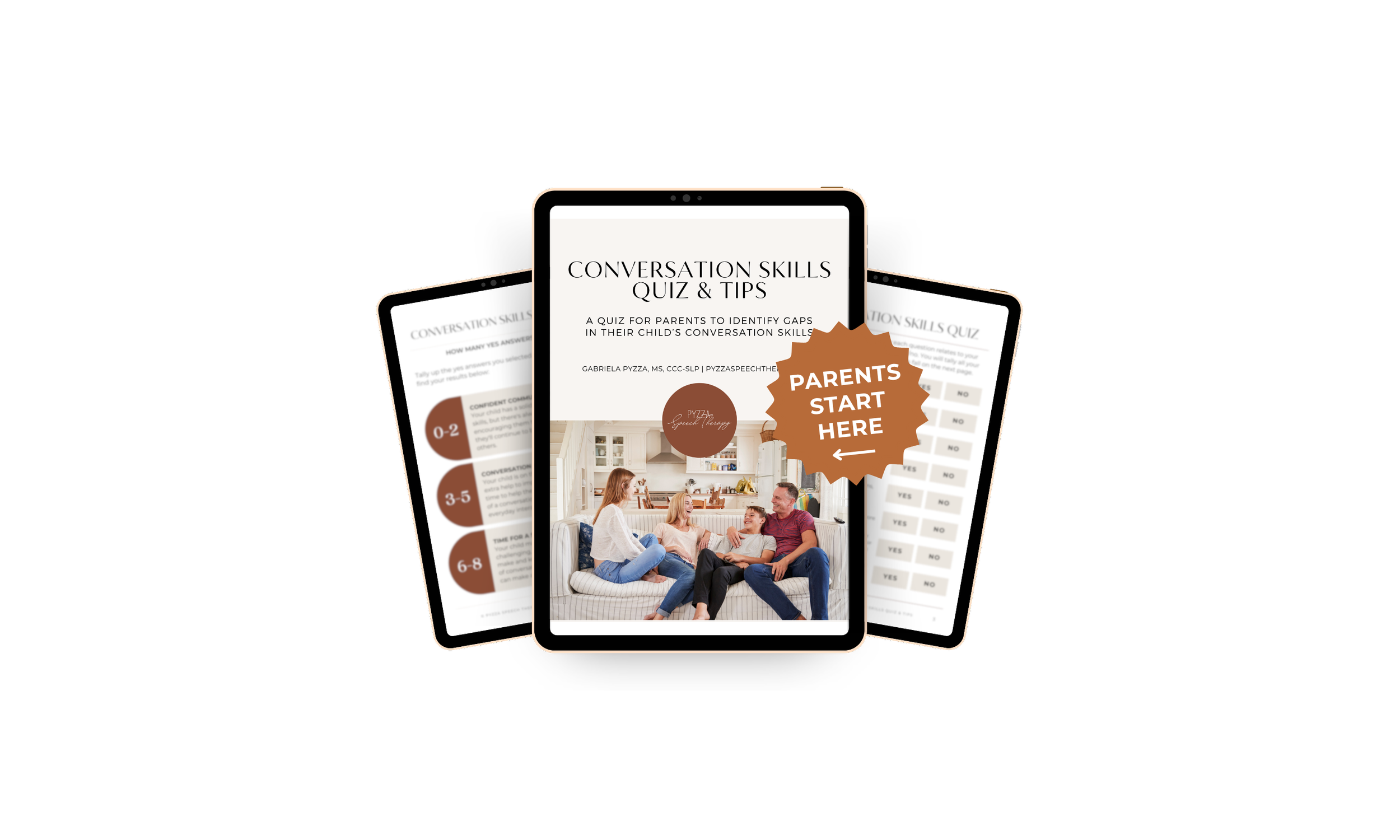
CONVERSATION SKILLS QUIZ & TIPS
Get a clearer picture of where your child is doing well and where a little extra support could make a real difference for them.
If you’re wondering about speech sounds, including whether your child’s sound errors are still expected for their age, you can download my free Speech Sound Milestones Guide to learn more about when different speech sounds typically develop and when to reach out for support.

Speech Sound Milestones Guide
This free guide breaks down when sounds typically develop and how to tell if it’s time to get support.
If you’re ready for more individualized support, I offer 1:1 speech therapy for social communication and speech sound disorders, as well as the CONNECT Program, an in-person social communication group for neurodivergent tweens, teens, and young adults in the Phoenix area.
Not local to Arizona? You can still access support through my self-paced Conversation Skills for Better Friendships digital course, created to help families work on practical conversation and friendship skills from home.
Wherever you’re starting, the goal is to better understand your child’s communication needs and find support that feels like the right fit for them!


